Manual Osteopathic Therapy
Please note: As I have just graduated from my MOT program, I'm currently waiting for my professional association, CMMOTA, to process my transcripts and assign my billing number. There is no guarantee of insurance coverage until this process is complete. I am expecting to be fully registered in August, at which point I will set up direct billing for those with coverage for MOT.


Osteoarticulations - gentle, therapeutic corrections of the spine, pelvis, sacrum, coccyx (tailbone), and other joints. Indications: I generally recommend this to everyone, unless you've had spinal corrections recently. A partial impingement of a nerve from a misaligned vertebra or other joint can cause symptoms that you aren't aware of yet, from muscle weakness to pins and needles to organ dysfunction. Treatment is usually about 20 minutes.
Myofascial Remodeling - reorientation of the connective tissue to its original function. Indications: scar tissue, old injuries, emotional injuries, surgery recovery, recurrent dysfunctions, postural patterns.
Visceral Manipulation - gentle treatment of the internal organs. Indications: digestive concerns, heart and lung restrictions, urinary tract dysfunctions, liver dysfunctions, reproductive organs and related hormone dysregulation, autoimmune conditions, whole-body wellness, postural imbalances.
Cranial Osteopathy (Involuntary Mechanism 1/2) - also known as Craniosacral Therapy; gentle corrections of the bones of the skull, face, and sacrum, as well as treatment of the dura, meninges, cerebrospinal fluid, and other soft tissues. Indications: headaches, trauma to the head or face, brain fog, hormone imbalances, mental health challenges, autoimmune conditions, mystery ailments, whole-body wellness.
Manual Lymphatic Drainage (Involuntary Mechanism 2/2) - flushing of lymphatic fluid from stagnant areas. Indications: swelling from acute injuries or surgeries, sinus issues, removing toxins, preparation for visceral manipulation treatment.
*Please note that this level of training does not qualify me to treat lymphedema or instances where lymph nodes have been removed. These conditions require specialized MLD training in order to re-map the direction of lymphatic fluid movement. *
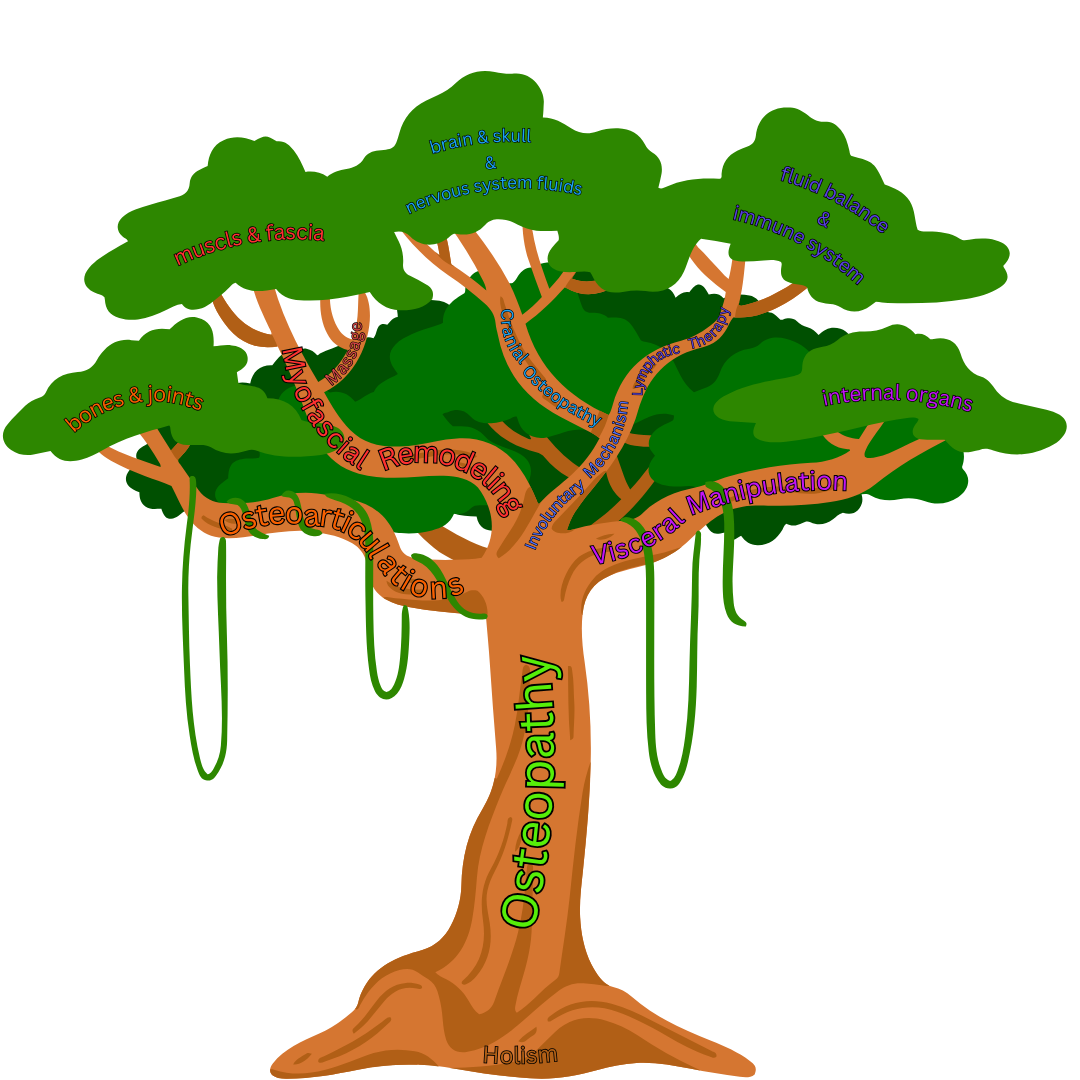
What is Osteopathic Therapy? - a manual (hands-on) therapy that seeks to resolve dysfunction in the body by addressing the root cause. MOT is deeply rooted in theories of holism, which is to view the body as a whole -"the whole is greater than the sum of its parts." With this perspective, the practitioner is able to discover lesions that do not, at first, appear connected to the symptoms but which are, in fact, the root cause.
This therapy is based on 4 pillars of practice - osteoarticulations, myofascial remodeling, involuntary mechanism, and visceral manipulation. From these pillars, there have emerged many specializations that you might be familiar with - such as craniosacral therapy (aka cranial osteopathy) which derives from involuntary mechanism, or fascial work which has taken the massage therapy world by storm in the last decade.
See below the tree for a complete description of each pillar.
Rates
Initial:
60 min - $150
90 min - $215
Follow up:
30 min - $90
45 min - $130
60 min - $150
90 min - $215
120 min - $275